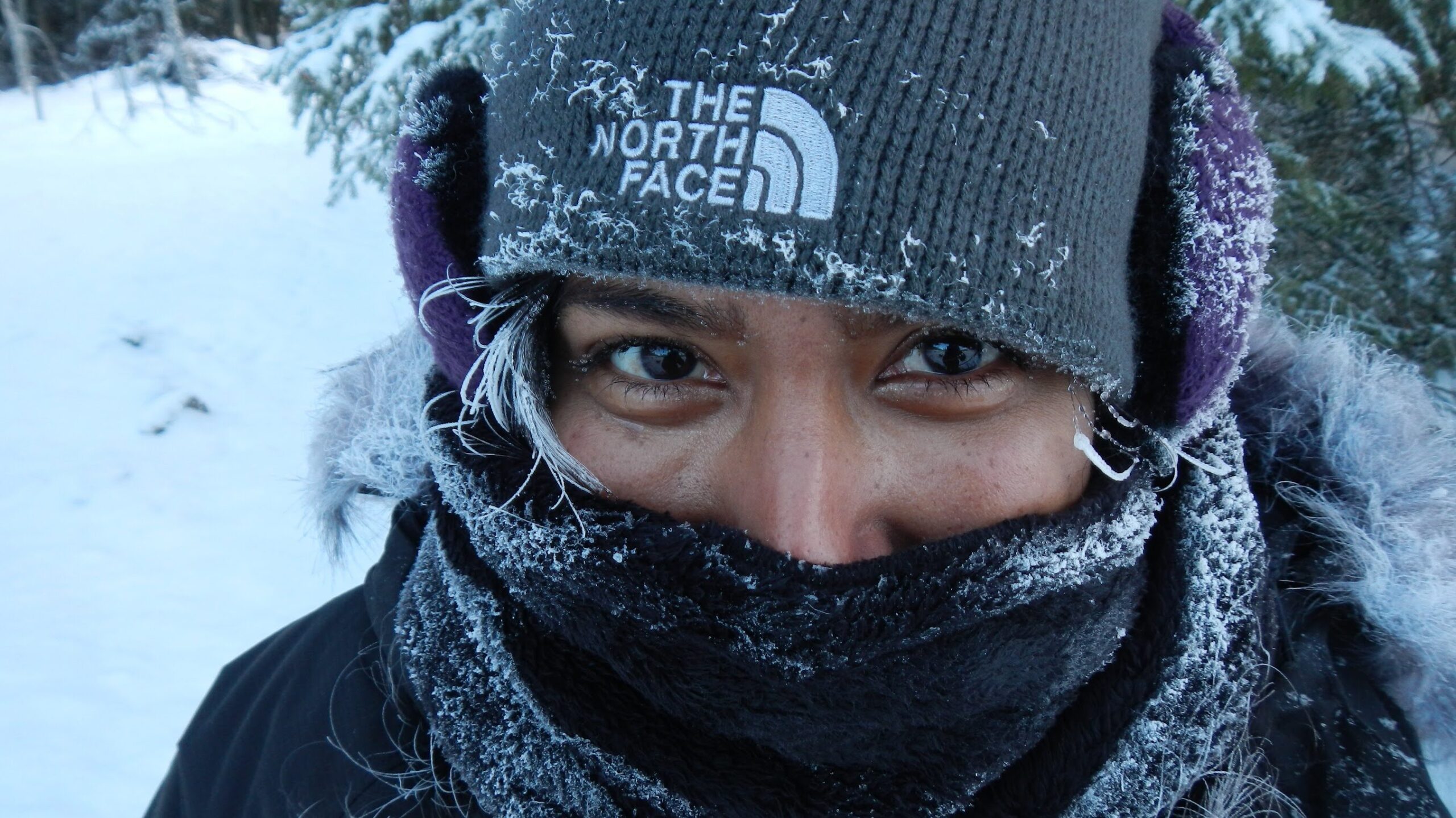
I was thirty one when I first held snowflakes, bunched together in my fist. Although I had travelled to North America and the UK the closest I got to the powder were the remnants of winter, piled under trees, tarnished by dirt. So, when I decided I wanted to roll, throw, possibly taste, dive into and make a snow angel for the first time I chose a part of the world with GUARANTEED abundance.
Are (pronounced Are Ray), Sweden, was my Scandinavian choice for my snowcapades. Yes, I ate it, snuggled under a blanket and drank hot cocoa in it, even ran out into the frosty air after a sauna and rolled around in it, discovered the crunch of snow under my boots made me hungry, had huskies pull me on a sled over it and went for a walk at night in complete darkness and silence in it. Each waking second I stepped out of my Caribbean, country girl skin and put on a winter coat.
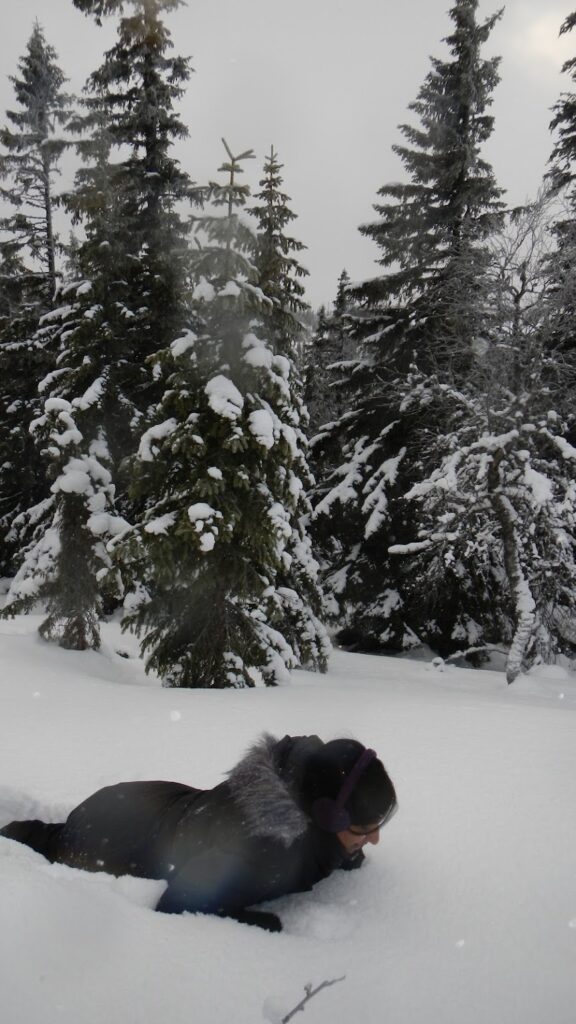
Tasting snow for the first time.
***
I was thirty two when I first saw mountaineers. It was also my second experience in snow, this time on Mount Blanc in Chamonix, France. My husband was on deployment in neighboring Switzerland, staying in a five star hotel with a two star Michelin restaurant, where we could eat for free. I like ‘free ting’ so I joined him. On his day off, up the cable cars we went. I was not dressed for the chilly air and stepped onto the viewing platform with an equivalent shock of sticking my head in a deep freeze. Not far away, one person, their face disguised by a balaclava, clutching trekking poles, trudged their way up the demanding slope.
“Why on earth would anyone do that. They could just take the cable car up” My judgy self exclaimed.
Well, call it what you will, The Universe or Karma, made sure I found out why.
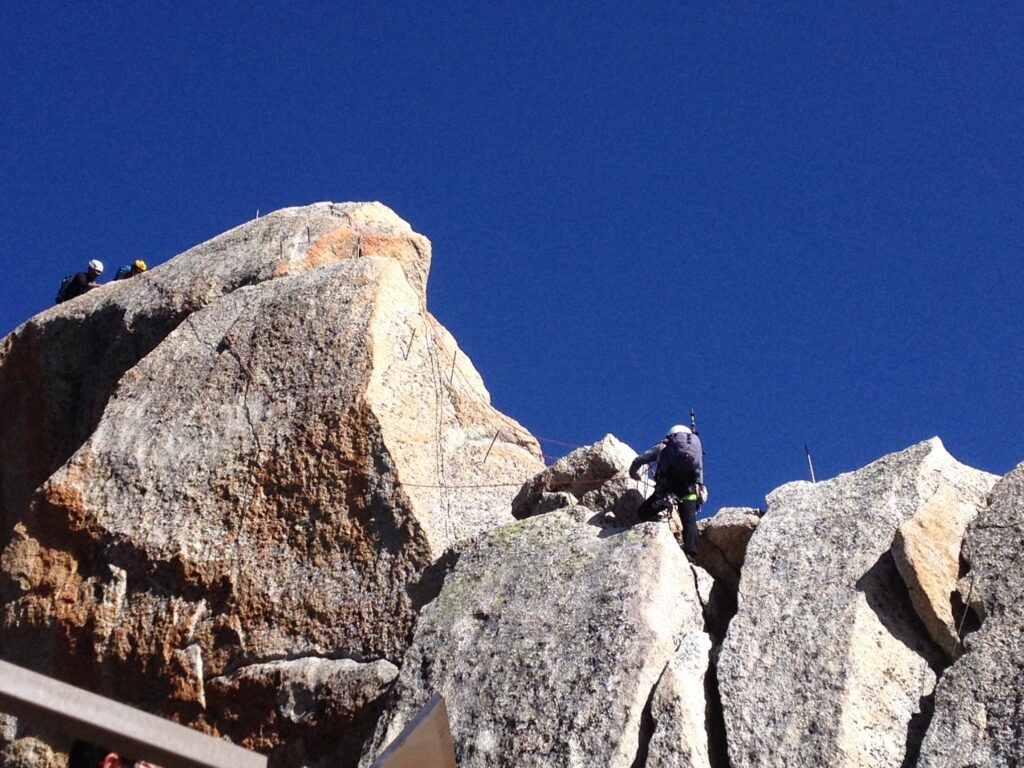
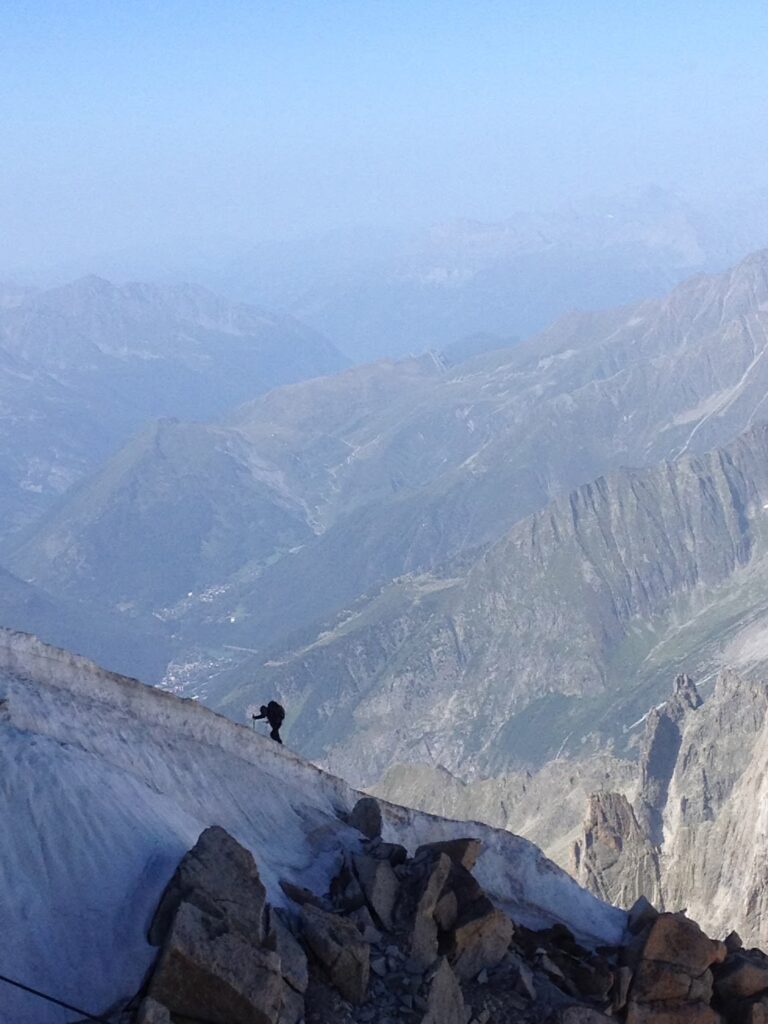
Seriously why? 🙂
***
On December 3rd, 2018, I was hospitalized. After three emergency surgeries, receiving eleven pints of blood (which is why I am an avid advocate for blood and plasma donations) and a year of tests and recovery I let go of who I was. The internal and external ‘Me’ had disintegrated like wet paper.
Bur during this heartbreak, a sliver hope sliced through my landscape. I discovered I had a brand new body. I ran my first 5k without stopping and lifted weights without my arms threatening to burn themselves off. I wondered if this was how ‘normal’ was supposed to feel.
But I could no longer face my colleagues at work who, when my husband called to advise I was in the hospital was told “You are messing with the schedule,” or being penalized for sick leave, with the opposite requirements for male pilots. I quit my job and told myself I was retiring, with no plan other than to ‘be happy.’ During this quest, banana bread and chocolate chip cookies provided a salve during covid lockdowns. But when restrictions were lifted I felt drawn to the bumps on the earth. I don’t know why. I have never figured that out. But I went with the pull. I trekked up a volcano named Acatanango in Guatemala, for the sole purpose of watching another volcano ‘Fuego’ erupt in the distance. I completed a mountaineering course in Colombia, attempted to summit Cotopaxi (a volcano in Ecuador), but turned around due to high winds and being given two left side crampons (spikes that tie onto your boots to grip the ice). Everest Base Camp was next, taking the route less travelled towards Tibet, then arriving at the rock with my flag having walked over a hundred kilometers. A friend in Nepal is a helicopter pilot so thankfully I did not have to walk all the way back, but flew back to Lukla, one of the most dangerous airports in the world. During this flight, the almost wilted stems of aviation were watered alive. I missed being a pilot and thankfully my ex-Boss’s boss had been trying to convince me to come back to work. I took the invitation. During my first year back, scrolling through social media one day I came upon a girl traveling to Antarctica to climb a mountain. I had no idea there were even mountains there. How was this possible? Did I have to take a ship and brave some of the roughest waters on earth along the Drake Passage? After some intense research, I read,
Imagine yourself on the summit of Mount Vinson 16,050 ft (4892 m), the highest peak in Antarctica and one of the coveted Seven Summits. Majestic, snow-covered peaks stand guard over vast glaciers below and in the distance, snow meets sky along a noticeably curved horizon. This is a moment to savor. All of the challenges you faced to get here only highlight the vast beauty before you and the sense of accomplishment that comes from achieving the extraordinary.
Mount Vinson lies in the aptly named Sentinel Range of the Ellsworth Mountains, deep in the interior of Antarctica. It was first summited on December 18, 1966 and for many years did not see a second ascent due to the challenges of accessing its remote location. In 1985, we pioneered logistics to support a private expedition to Mount Vinson and 30+ years later, we continue to guide climbers to the top of the bottom of the world!
You’ll ascend the Branscomb Shoulder Route which has become the “standard route”, climbing gentle glaciers, 45° snow covered slopes, an exposed high plateau, and spectacular summit ridge. The rate of ascent and daily climbing plan set by your experienced mountain guide will be geared toward the safety and success of your climb. To climb Mount Vinson is to challenge yourself on a mountain like no other in one of the most remote regions on Earth.
My body was itching for a test drive, so I signed up.
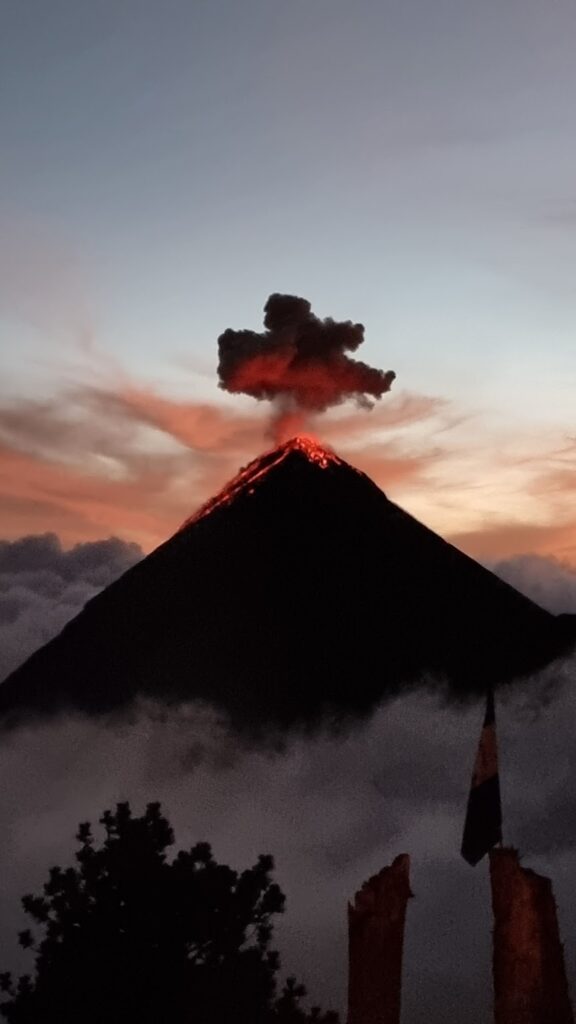
Vulcan Fuego, Guatemala.
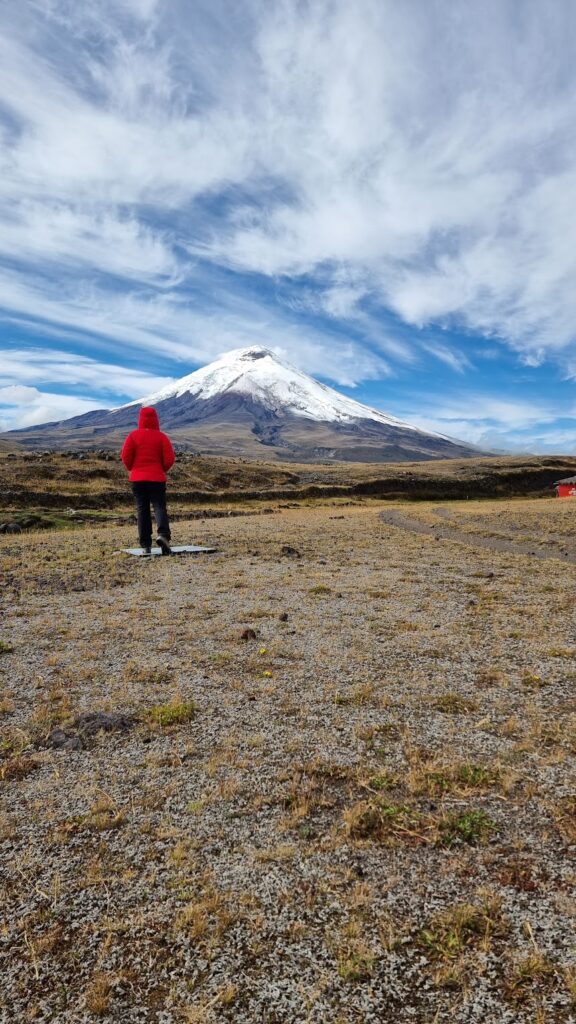
Cotopaxi, Ecuador
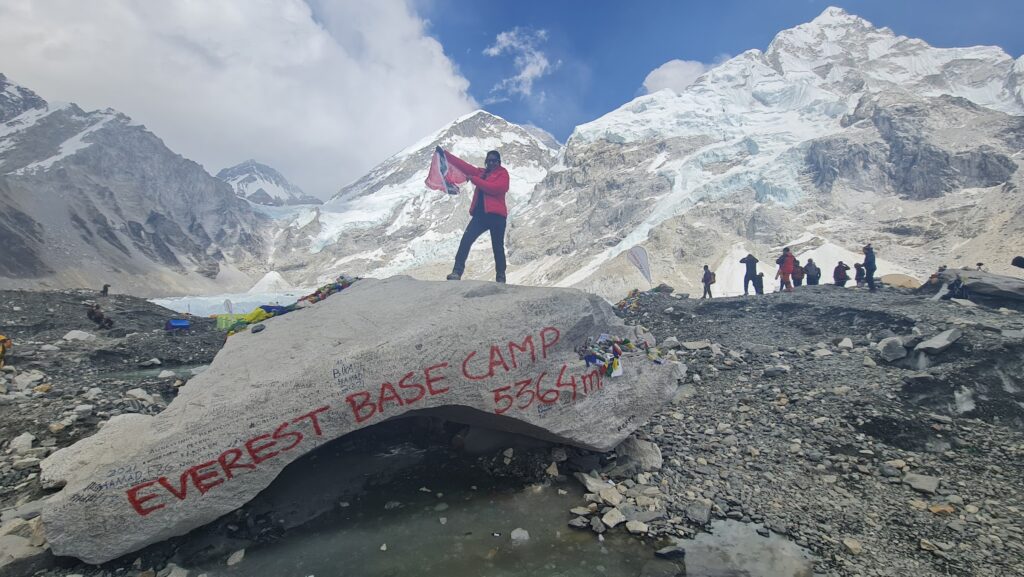
Everest Base Camp, Nepal.
***
It’s not called one of the most remote regions for nothing. Getting there involved the following flights.
Abu Dhabi, UAE – Madrid, Spain.
Madrid – Santiago, Chile.
Santiago – Punta Arenas, Chile.
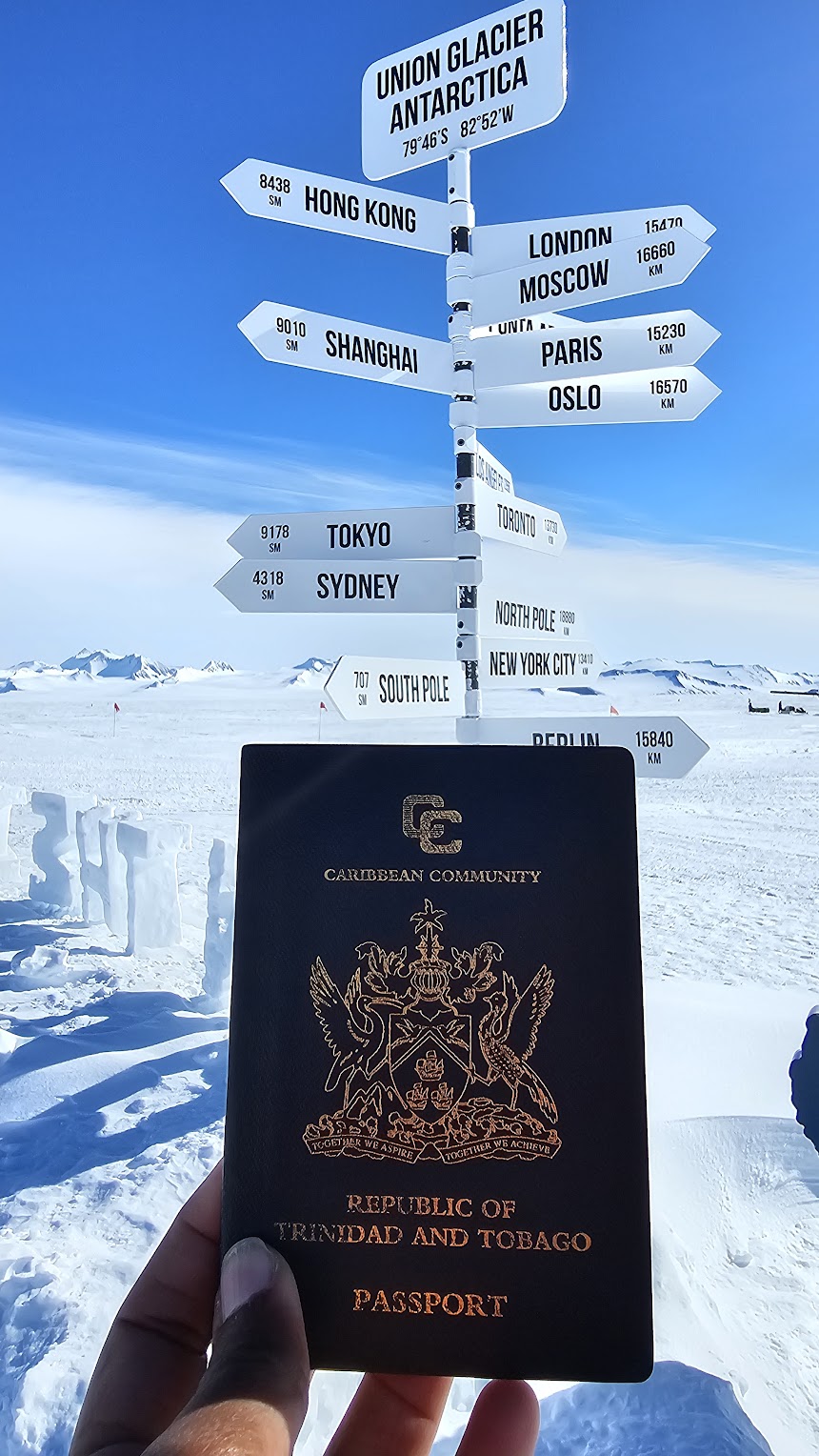
Punta Arenas – Union Glacier, Antarctica.
But as the chartered Boeing 767 put the ocean behind and flew onto the continent of Antarctica any lingering jet lag was replaced by pure, unfiltered, cell tingling joy.
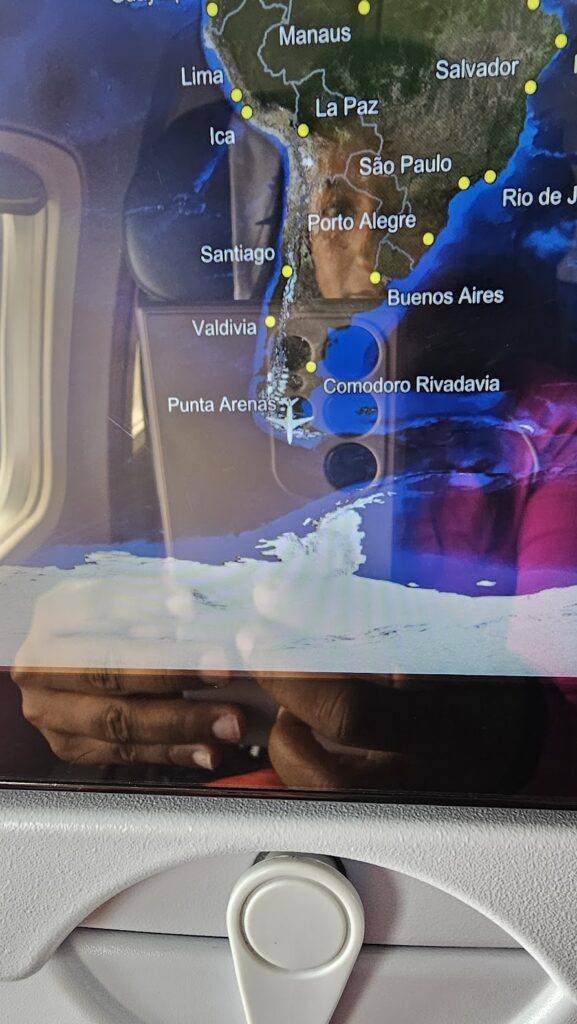
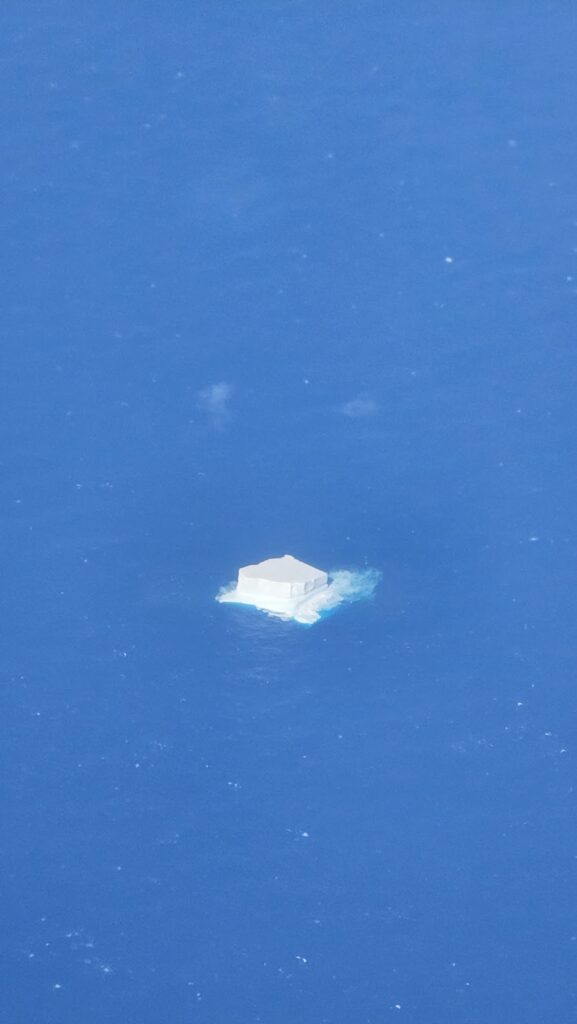
Zoomed in on an iceberg from 30,000 feet. Samsung phones folks 🙂 Some of the white spots are waves, crossing the Drake Passage.
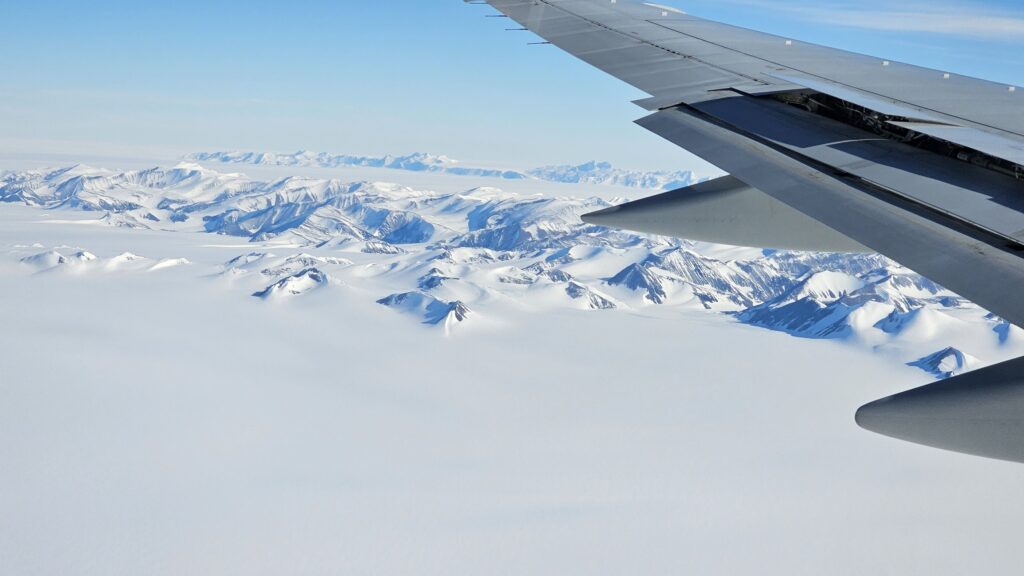
About an hour before we landed the captain turned off the fasten seat belt sign. This was our notice to start putting warmer clothes on. I layered on my poofy red jacket and blue hat. In no way color coordinated but I live somewhere with no outdoor clothing stores so the dregs of online shopping is what I end up with. Returning stuff is a nightmare which is why some of my trousers are too big and I have pink and white base layers, orange and blue outer layers, a thinner purple jacket, green waterproof upper layer, pink face buffs, and both blue and black trousers. You will never loose me in the mountains, just look for the walking, talking bag of Skittles.
The airplane continued its descent. The carpeted, milky landscape was even more intriguing as so much of the continent was unexplored. Ahead of the airplane, a naturally occurring long stretch of runway, four kilometers deep of blue ice awaited the rubber tires. We touched down with frozen crystals blasting from the tires and a warm fleet of vehicles to transport all the passengers to temporary and only seasonally occupied camp named Union Glacier.
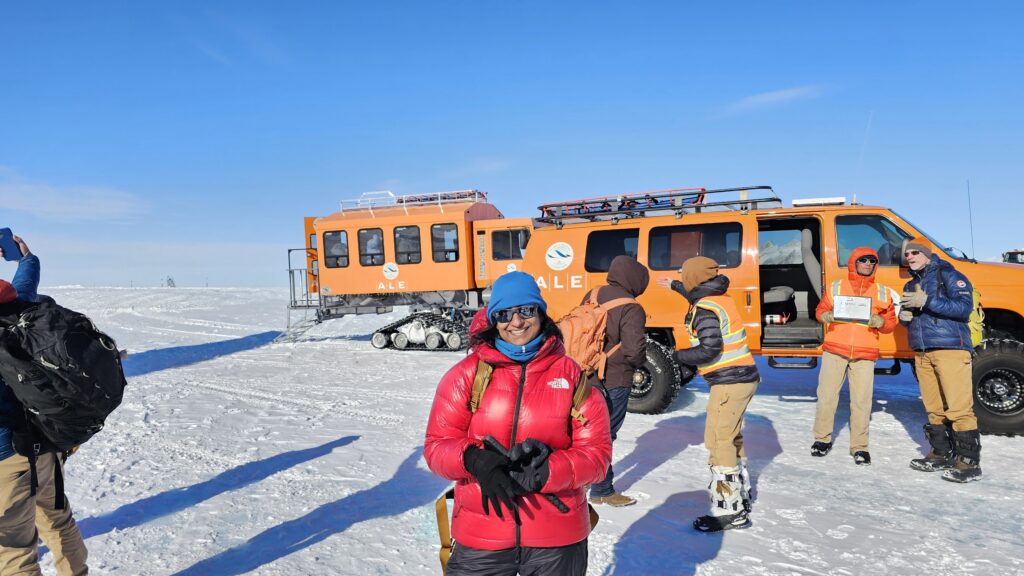
But the word temporary is misleading. A food tent with a buffet, snacks available twenty four seven, hot showers and even sit down toilets were available. There was a walking/ running circuit, a gym, library and fat tyre bikes. My two person tent was tall enough to stand in and held a cot with a mattress and ample space to unpack. Mountains flanked the tents and I inhaled the pure, chilled air.
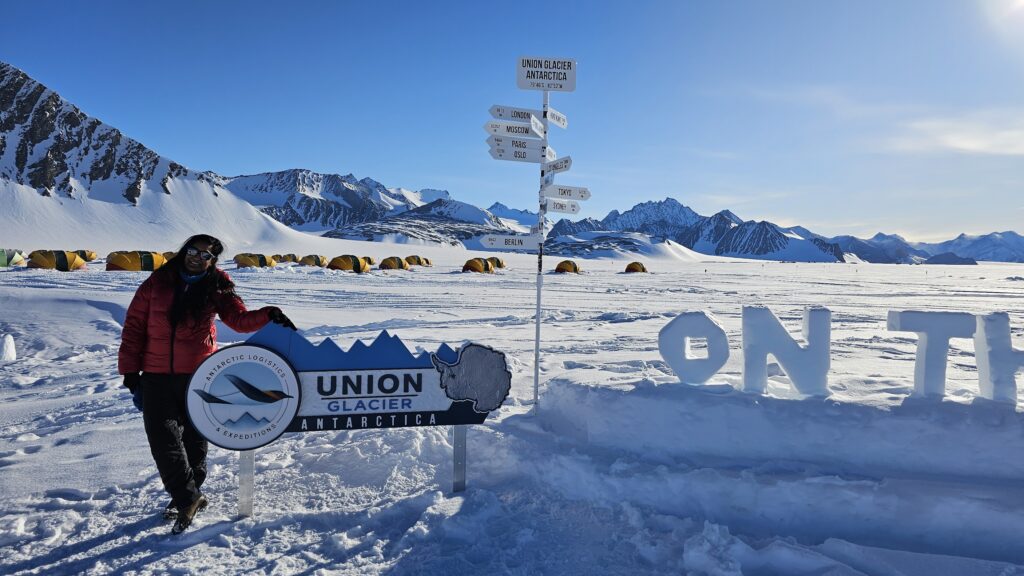
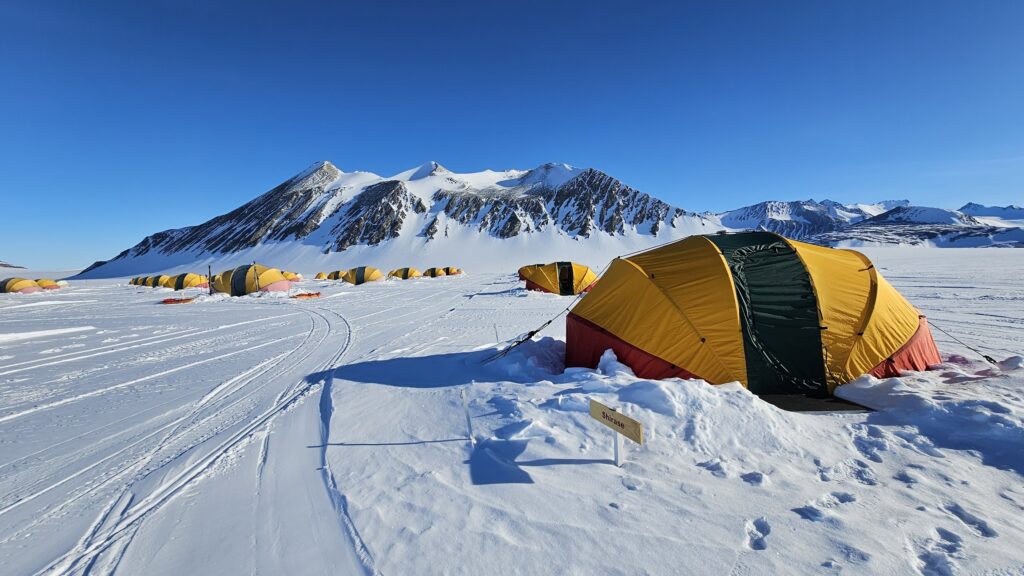
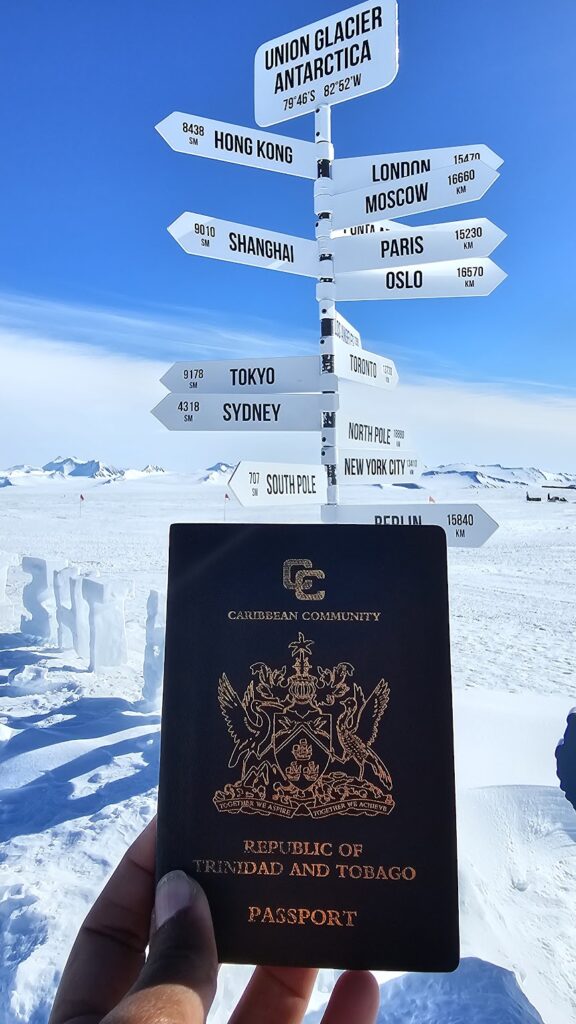
The next day I packed again and walked over to the smaller airplanes, outfitted with skids that would fly us to Base Camp. I am a backseat driver so I clutched the seat as we lifted off the ice. Flying further inland our 150 liter duffel bags held strong in a Jenga block as we bounced over vanilla ice cream peaks. “I’m here, I can’t believe I’m here” I kept repeating to myself while tears ran down my face pressed against the window.
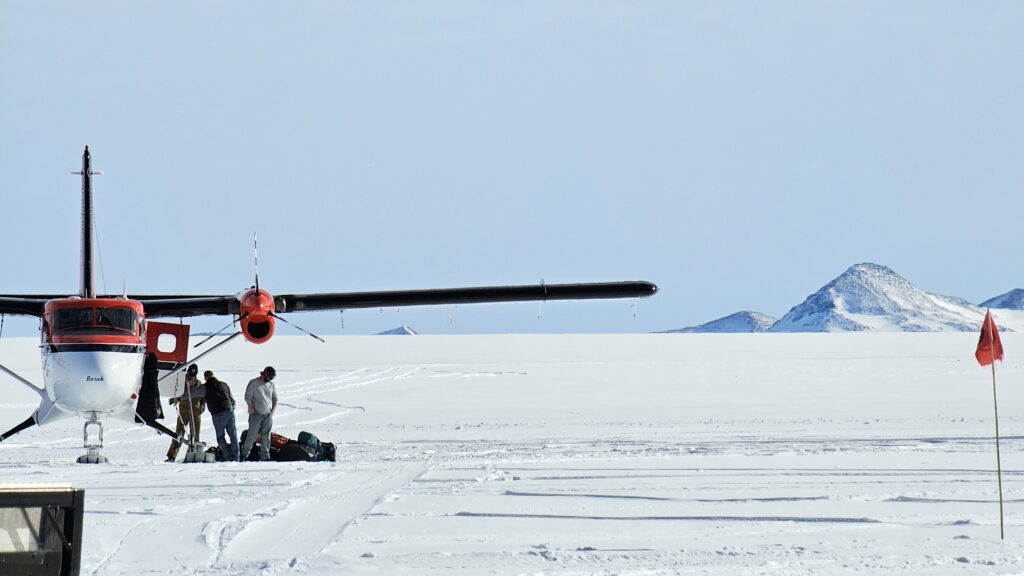
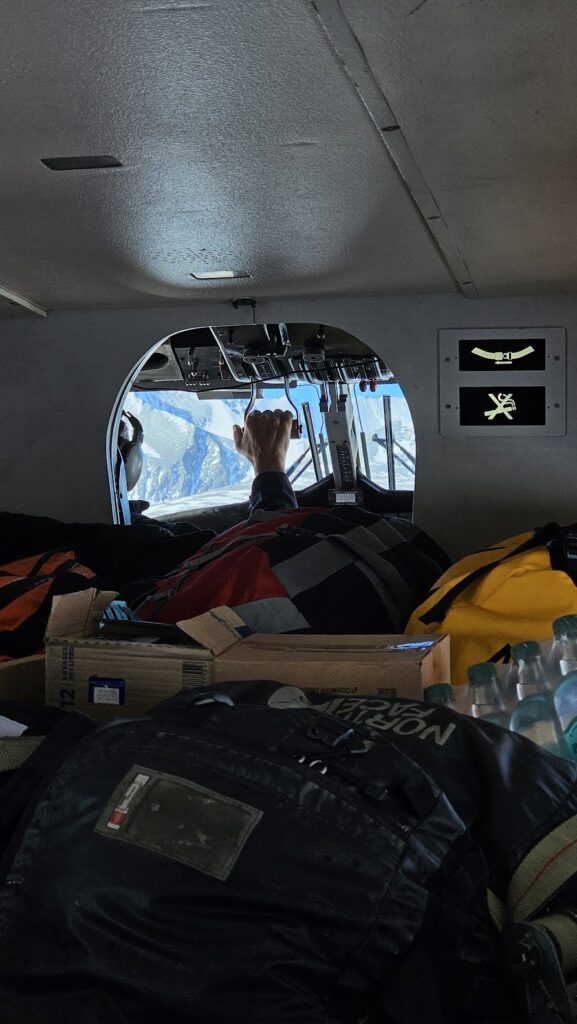
My first landing on ice with skids was uneventful as glided to a stop on the snow. Here, at Base Camp, I also shared a tent but the toilets were buckets with a seat and no ceiling. We had a steak dinner with vegetables and cake for dessert. The next day, my male teammates and I hung out in the dining tent and taped the tops of our ice axes. This would help insulate our fingers against the freezing metal. Some of us cut holes in our face buffs to use as a face protector.
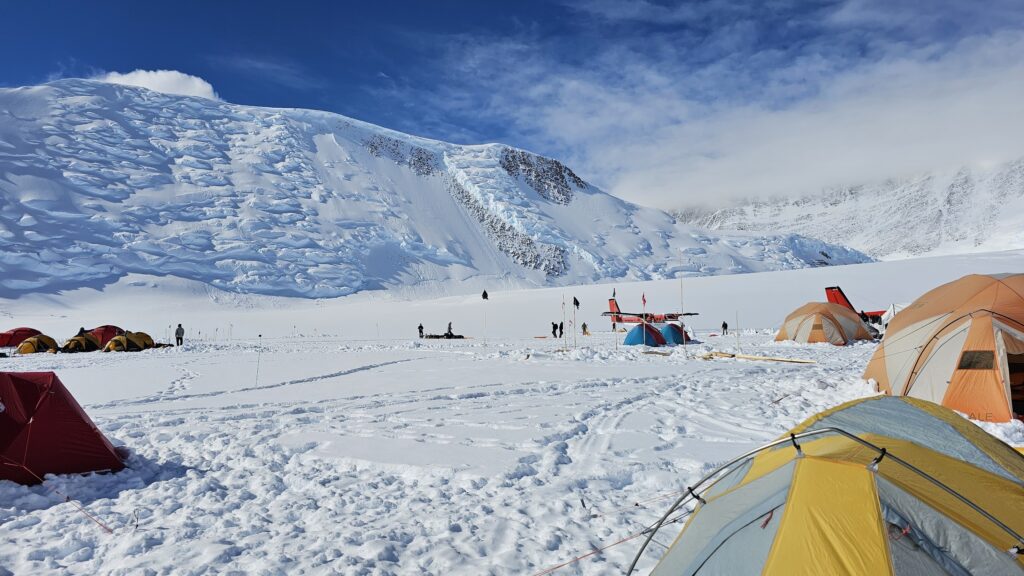
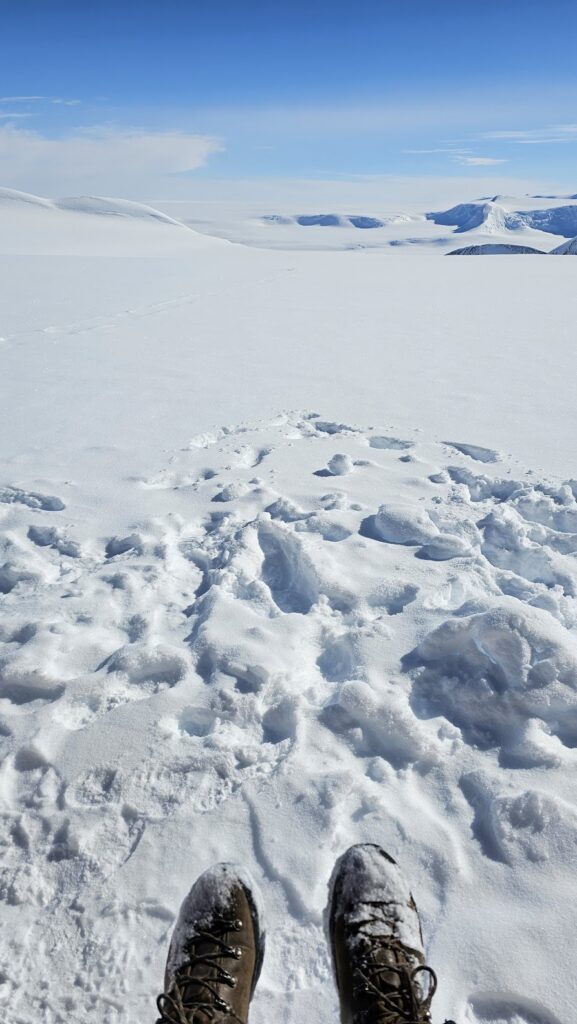
View from the toilet.
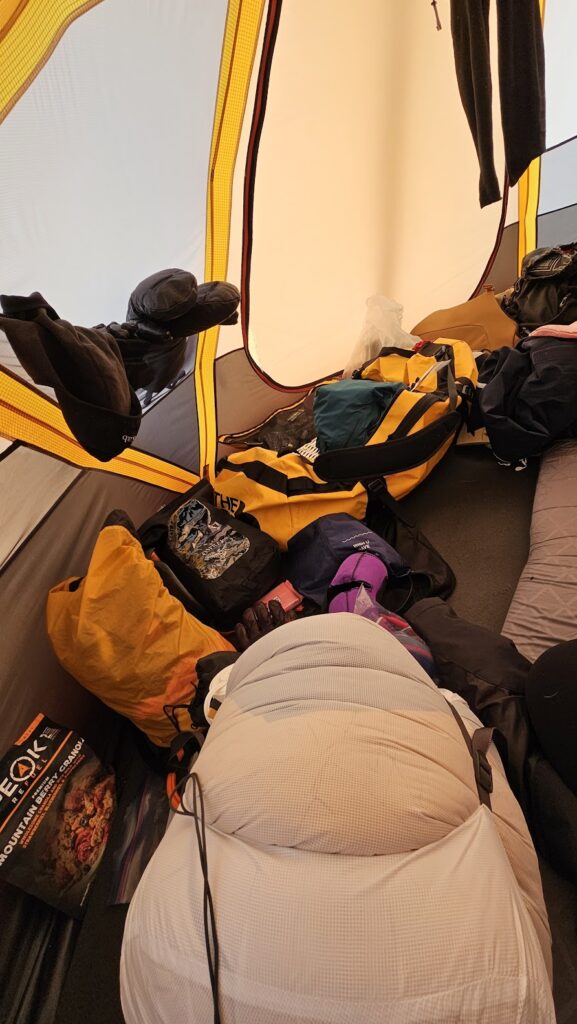
The bain of trekking/mountaineering is packing and unpacking.
Step outside.
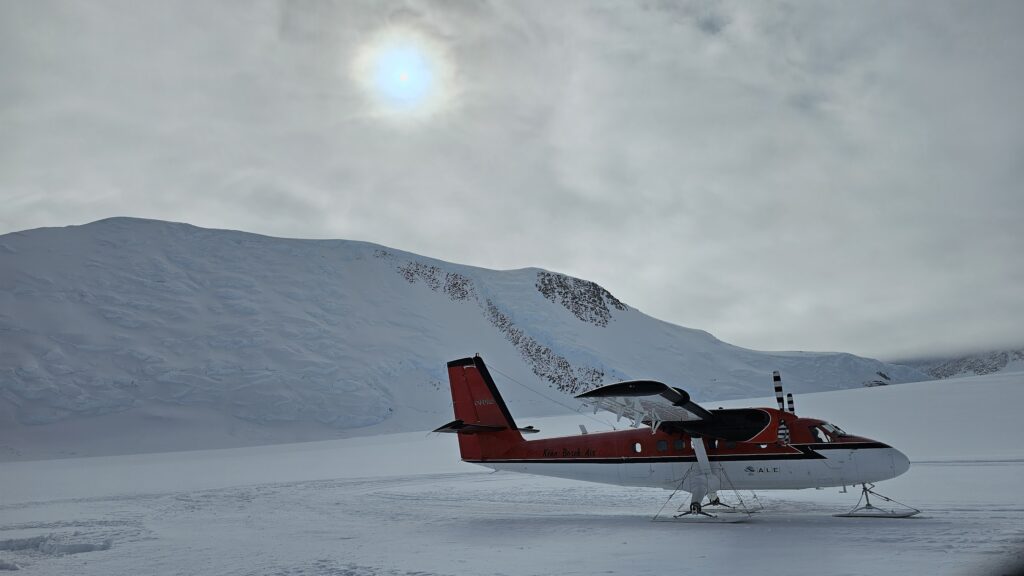
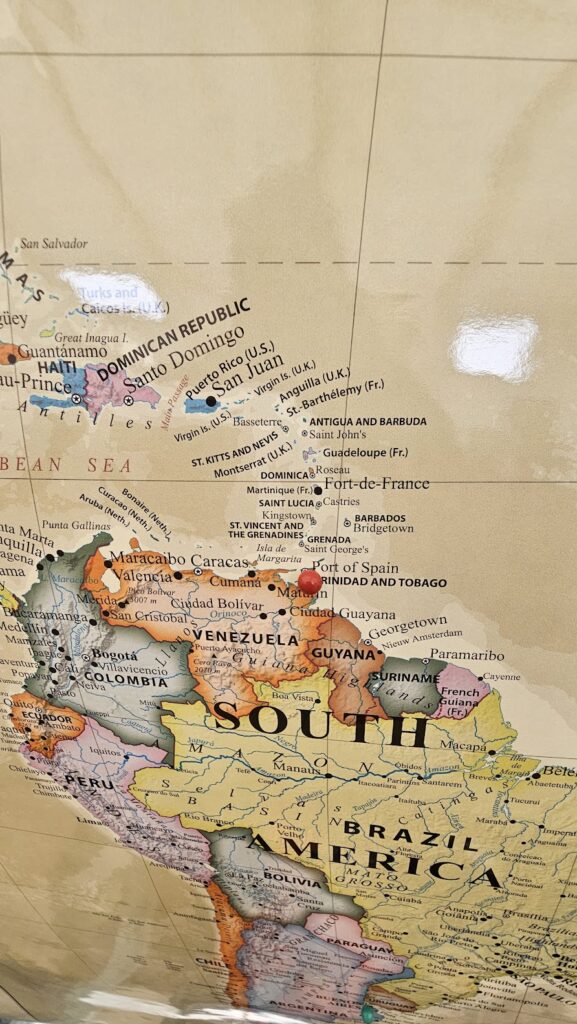
Red pin marks the first one 🙂
The next morning, we assembled in line with sleds separating us, wearing our backpacks. I had been told that the sled would be heavy and the backpack light by the company I booked with, but that had been reversed. The nine kilometer journey with gun metal grey skies and ice crystals forming on my body was tedious, crossing over crevasses and glaciers gaining six hundred and fifty meters of elevation.
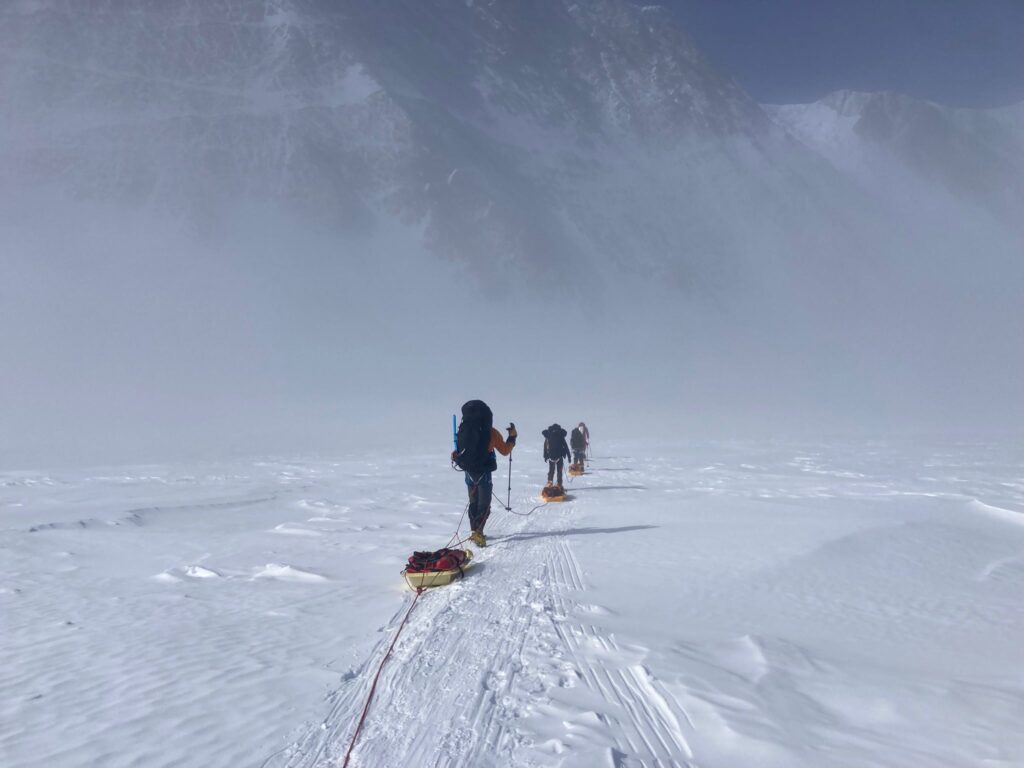
Photo courtesy Josh Braid.
Upon arrival at Low Camp (2150 feet/650 meters of elevation gain) later that day, we had to set up our tents. Digging into the ice with shovels for blocks to pin the tents down was also a first for me, and it became apparent that although companies accepted people from all over the world, there was judgement for those of us, like me, who did not live in cold countries.
“Oh, you’re the one who prefers the warm over the cold” someone had remarked. I had only answered a questionnaire honestly before I was accepted on the expedition and questioned myself whether I should have lied. But manual labor and snarky comments aside, it was a magical setting. Mountains shielded us and the pure untouched state only stressed how grateful I was again to be there. With only a scattering of tents and people, the snow absorbed any footprints or clanking utensils. The silence was mesmerizing.
The following morning, we stayed cocooned in our minus twenty degree Celsius rated sleeping bags until the sun warmed the tents. Although it was a rest day, it did not involve laying around. Instead, we practiced working the fixed lines, a thousand feet of which we would attack the next day (fixed lines are pieces of rope already attached by screws to the mountain. We attach ourselves to the lines via carabiners). Besides no available runway for rescue, the remote wilderness could also be measured by the ‘toilets.’ Snow blocks were piled high enough to shield anyone squatting into a bag or using their ‘pee bottles.’
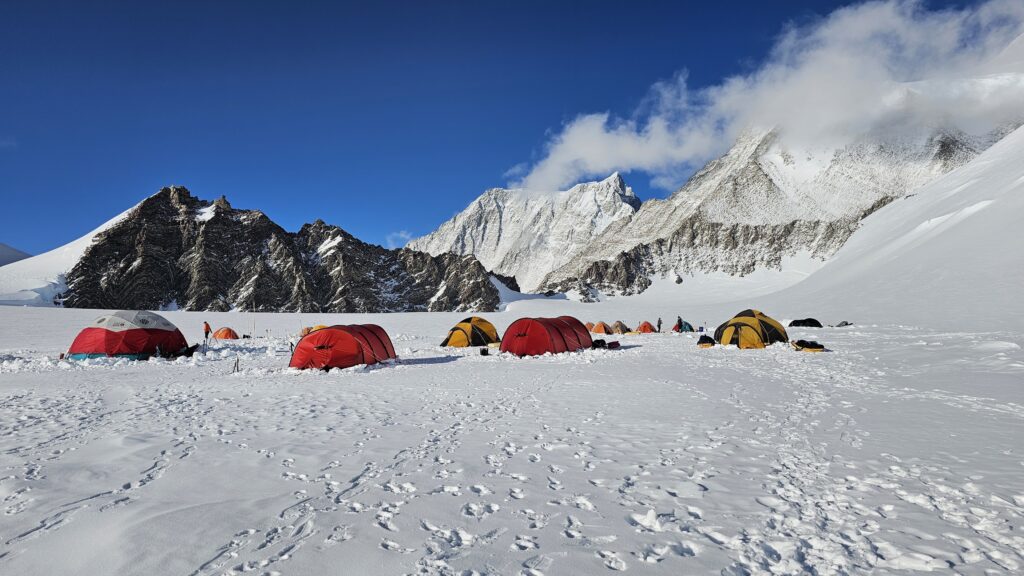
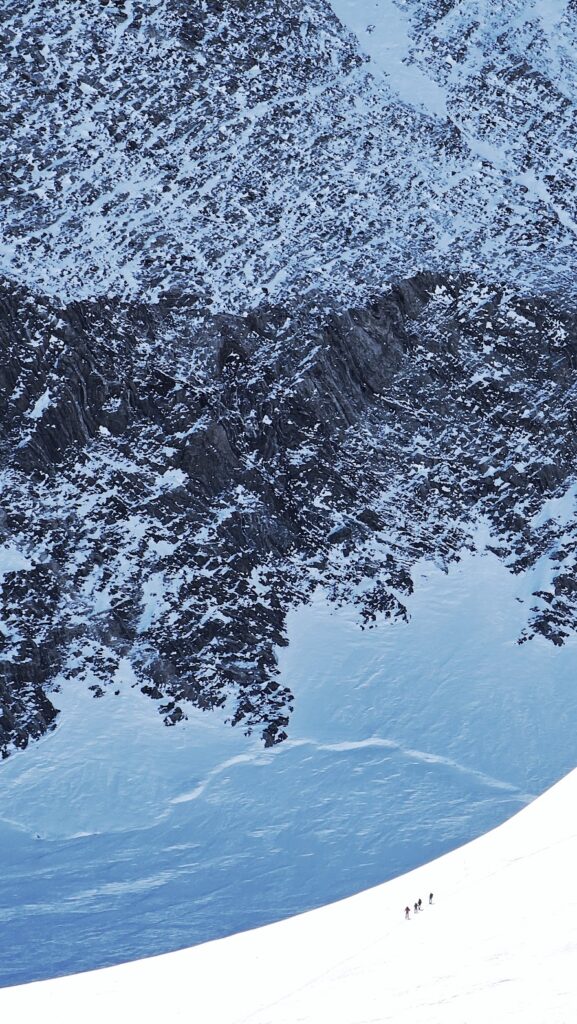
One of my favorite photos, taken from Low Camp
The hardest day of a mountain is usually the summit day. But on Mt. Vinson, it was the journey from Low Camp to High Camp. The snow slopes range from 35 to 40 degrees and involves constant bending over to unclip and clip the carabiners from the rope, pulled impossibly tight. Now with twenty five kilos (approximately fifty pounds) on my back (the sled could not be taken as the slope was too steep.)
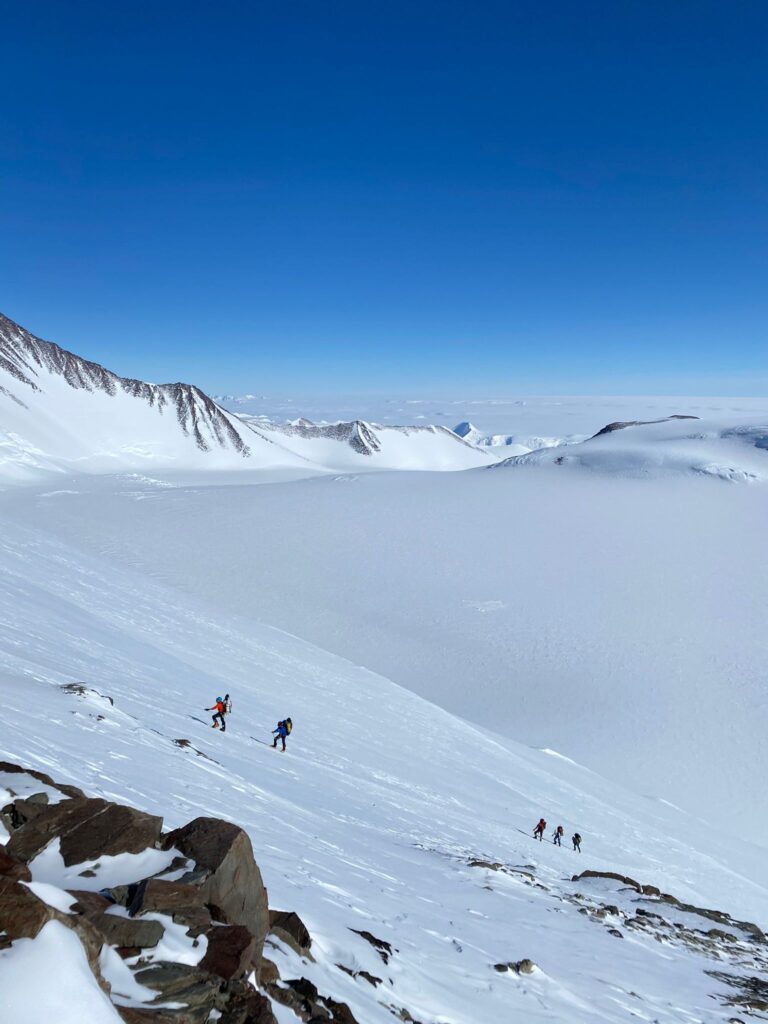
Photo courtesy Josh Braid
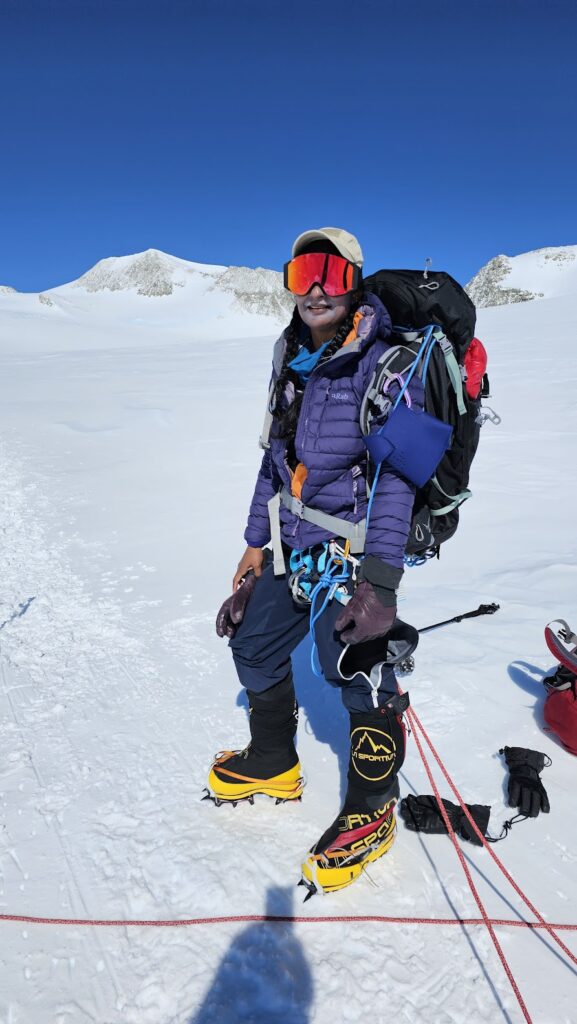
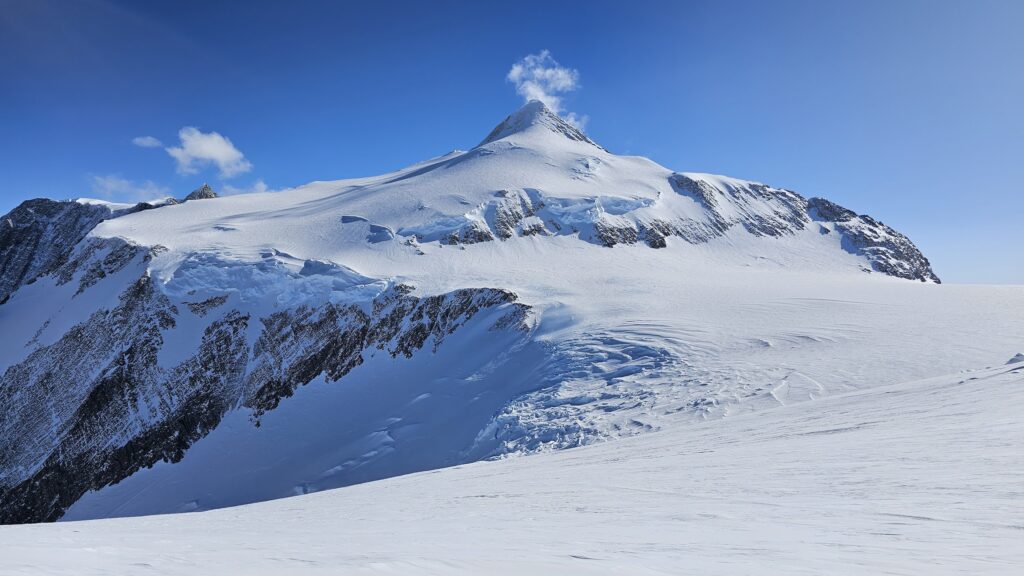
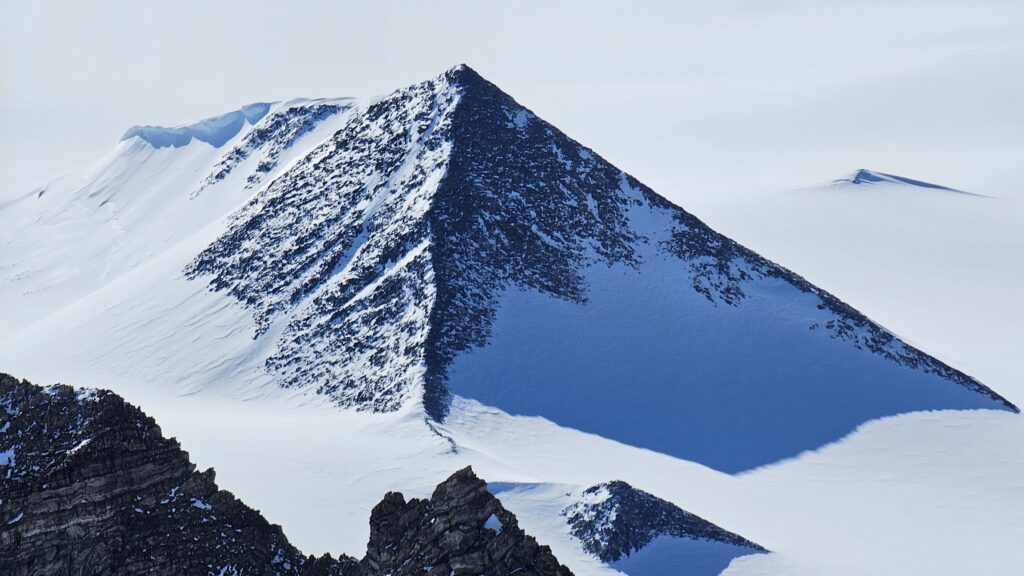
View from High Camp. The peak in the foreground is not Vinson.
Arriving at High Camp, 12,400ft/3770m, I used every mental trick to keep my legs moving. The straps on my backpack had dug into my shoulders and hips, rubbing them purple. We had climbed over 3550 feet/1020 m of elevation so taking the crampons off, unzipping and wiggling out of my boots and setting up my sleeping bags were monumental tasks. Sleep was fitful as we were above ten thousand feet, the air thin and frosty.
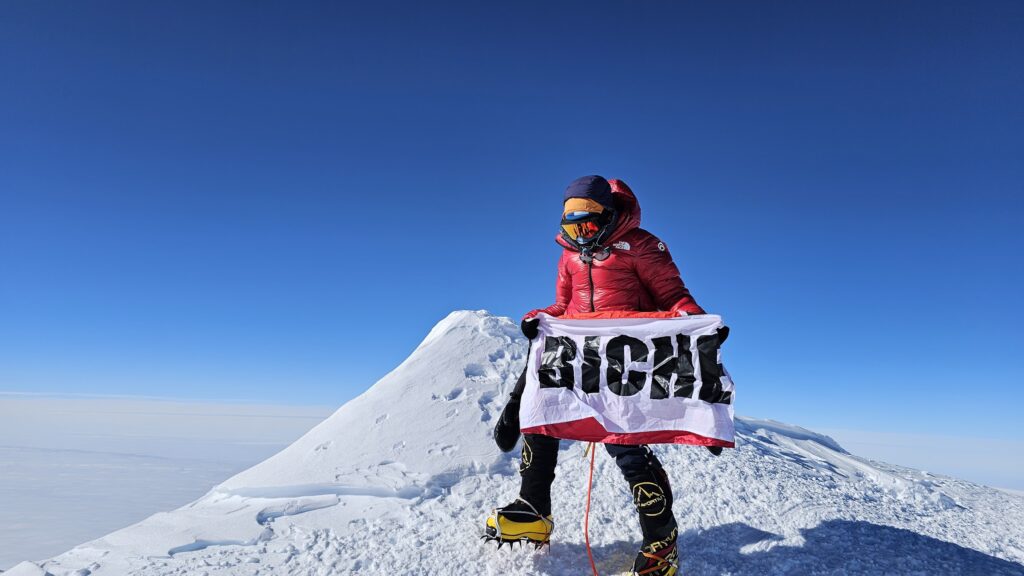
But two days later, on December 25th, I woke up, forced breakfast down, and piled on five layers of clothing on my upper body and two on my lower body. I left High Camp in low spirits, but as I gained altitude, my body seemed to inhale strength. It was still a grueling day, gaining 2670 feet/1120 meters to the proud summit of 16,00 feet/4892 meters, but with my backpack filled with only extra clothing, food and fluids, the literal weight lifted from my shoulders felt like I had sprouted wings. Reaching the summit, I stuffed my emotion to keep my mind clear. There was no room for mistakes. I quickly pulled out my flag from my backpack, took photos and then we stated our descent back to High Camp. In minus thirty degrees Celsius, the probability of frostbite (an injury caused by freezing of the skin and underlying tissue, which can lead to gangrene and blackened dead tissue, and in extreme cases, death) was elevated.
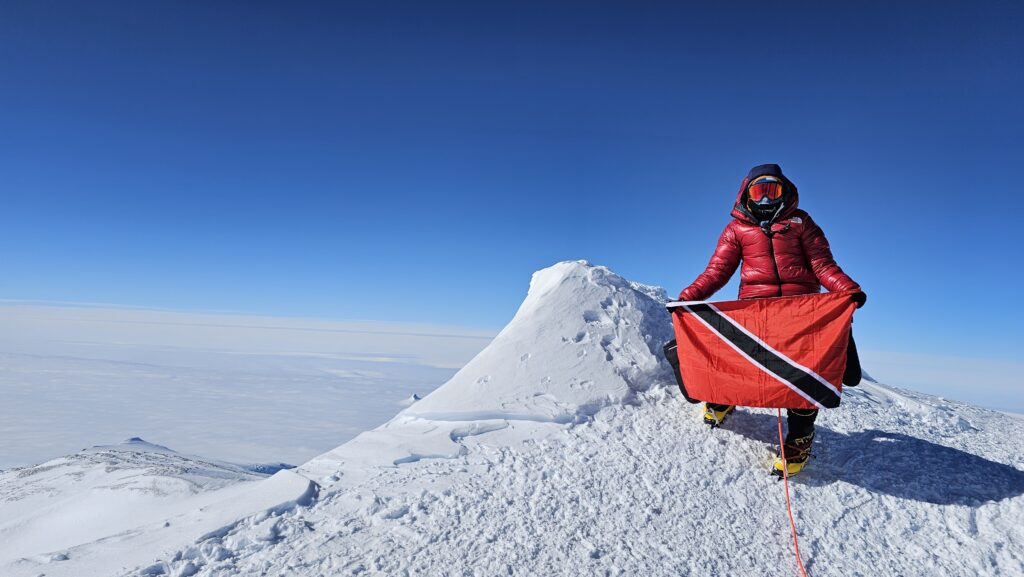
With no internet or phone connection, my journey played through my mind, in flashes of white. I was not special for doing this, but each step was a milestone for the terrified girl on the hospital bed, who could not walk just five feet after her last emergency surgery.
My guide came over to check on me and showed me some photos he had taken with his phone.
“I was wondering why you had BITCH written on your flag, but I thought to myself, this is probably not the best place to ask. Now I see what it is.”
I double over and in between giggles I explain how the words painted on the reverse of my flag written in black letters ‘BICHE,’ was pronounced.
“That’s where I’m from in Trinidad” I explain.
A Biche girl, always.